
PPC Agency in Jacksonville for Google Ads Management
More ad spend does not fix weak tracking, loose targeting or a landing page that loses qualified visitors. It usually makes those problems more expensive.
OzoPro provides PPC management for Jacksonville businesses that want clearer control over where budget goes and what happens after the click. We manage Google Ads around search intent, account structure, conversion tracking, landing-page alignment and ongoing optimization, with decisions based on the actions that matter to the business.
If an account is already running, we start by finding what is producing useful results, what is wasting spend and what the current tracking can actually prove. If the account is new, we build the campaign structure around the offer, service area, conversion path and available budget before traffic starts.

What Does a Jacksonville PPC Agency Do?
A Jacksonville PPC agency plans, builds and manages paid advertising campaigns for businesses that want to reach people actively searching for their products or services. PPC management can include keyword research, negative keywords, campaign structure, ad copy, location targeting, bid and budget management, conversion tracking, landing-page review, testing and reporting.
Good PPC management is continuous. Search behavior changes, competitors adjust, costs move and automated bidding responds to the data it receives. The account needs regular review so budget stays connected to useful customer actions instead of click volume alone.
PPC Management Services for Jacksonville Businesses
The right campaign mix depends on how customers search, what the business sells and what can be measured after someone clicks. OzoPro does not force every account into the same setup.
Search campaigns are built around active demand. We group keywords by intent, choose match types deliberately, review search terms and maintain negative keyword coverage so the account is less likely to spend on searches that do not fit the offer. Ad copy is written to match the query and the page the visitor reaches next.
Day-to-day Google Ads management includes campaign organization, budgets, bidding, search terms, ads, assets, audiences, location settings and conversion data. A campaign that was well structured at launch can still lose efficiency later if those parts are left unchanged while the market moves.
Performance Max and Automated Campaigns
Automation can help with bidding and distribution, but it still needs a clear objective and reliable conversion signals. We use automated campaign types when the account has enough structure, useful data and suitable creative to make the output worth evaluating. Automation is part of the system, not a reason to stop reviewing the account.
Remarketing and Display Support
Remarketing can help a business stay visible to people who have already interacted with the website or another campaign. Display activity may also support awareness or re-engagement. These campaigns are used when they have a clear role in the customer journey, not simply because the inventory is available.
YouTube Advertising
YouTube can support awareness, consideration and remarketing when the audience, offer and creative make sense for video. Campaign setup should still connect to a defined objective and measurable actions, rather than treating views as the final outcome.
Landing-Page Alignment
A qualified click can still be wasted by a generic page, a slow mobile experience, a confusing offer or a form that asks for too much too soon. When the page itself is limiting performance, web design and conversion improvements may need to be part of the solution. We review the path from search query to ad to landing page so the message remains consistent and the next step is easy to understand.
Conversion Tracking and Reporting
Calls, forms, purchases and other meaningful actions need to be measured as accurately as the setup allows. Tracking quality matters because bidding systems and reports depend on those signals. Reporting should explain what changed, what the account produced and where the next decision should be made.
Search-Term and Budget Control
Search terms, negative keywords and budget allocation are reviewed together so spend can move toward campaigns and queries that are producing more useful customer actions.
Where PPC Budgets Usually Get Wasted
Most inefficient accounts do not have one dramatic problem. Waste usually comes from several smaller issues working together. The account may be attracting the wrong searches, measuring weak actions as conversions, sending good traffic to the wrong page or allowing an automated strategy to optimize toward a goal that does not reflect lead quality.
This is why increasing budget is not always the first move. Before scaling, the account should be able to show that targeting, tracking and the conversion path are strong enough to justify more spend.

Search intent, ad message or landing-page mismatch.
Weak negative keyword coverage or loose targeting.
Conversion goals, keyword intent or offer qualification need review.
Tracking setup or conversion definitions may be unreliable.
Budget allocation, bidding or campaign structure may need adjustment.
The system may be optimizing toward the wrong conversion signal.
The problem may be the page experience after the click.
Tracking, Landing Pages and Automation Need to Agree
Modern Google Ads accounts rely heavily on automation. That can be useful, but automated systems learn from the goals and conversion signals they are given. If the account counts duplicate form submissions, low-value actions or calls that never become real opportunities, the system can become very efficient at finding more of the wrong outcome.
The same principle applies to landing pages. If the ad promises one service and the page opens with a broad company message, the visitor has to work harder to confirm they are in the right place. If the page is slow, the form is difficult on mobile or the call to action is unclear, campaign optimization inside Google Ads cannot solve the entire problem.
Human oversight still matters. Someone needs to decide which conversions count, which search terms are irrelevant, which campaigns deserve budget, when creative should change and when the real issue sits outside the ad account.

Conversion Signals
Bidding systems should learn from actions that actually matter to the business.
Landing Experience
The page should continue the promise made in the ad and make the next action clear.
Human Oversight
Automation still needs decisions about search terms, budget, lead quality and campaign priorities.
Jacksonville Campaigns Should Reflect the Real Service Area
A Jacksonville campaign should be built around where the business can actually serve customers. For a local service company, that may mean Jacksonville and selected surrounding service areas. A B2B company may advertise across a wider region. An ecommerce business may have little reason to restrict campaigns to one city at all.
Location settings, budgets, ad schedules and landing pages should follow the sales model. We review geographic performance so spend is not expanded simply to make the campaign look larger. Local relevance is useful when it matches real serviceability and customer demand.

How OzoPro Manages PPC Campaigns
Audit the Account and Conversion Path
We review account structure, historical performance, search terms, conversion actions, budgets, landing pages and current targeting. For a new account, the same questions are used to plan the structure before launch.
Define the Campaign Priorities
The account is organized around the products, services and customer actions that matter most. Keyword groups, exclusions, geography and budget are planned with those priorities in mind.
Confirm Measurement Before Scaling
We check whether calls, forms, purchases or other key actions are being captured in a way that makes the data useful. A campaign should not be scaled confidently when the account cannot distinguish a meaningful conversion from a weak one.
Launch, Test and Optimize
Search terms, ads, bids, budgets, devices, audiences, locations and landing-page performance are reviewed as new data comes in. Changes are made for a reason, then evaluated against the outcome they were meant to improve.
Report What Matters Next
Reporting focuses on the numbers that help make decisions. Depending on the account, that may include conversion volume, cost per acquisition, lead quality, revenue, conversion rate and campaign efficiency. The point is to understand what should be kept, changed or tested next.
How to Compare PPC Agencies in Jacksonville
If you are comparing a PPC company in Jacksonville, the proposal should make it clear how the account will be managed after launch. A polished setup is useful, but most of the value in PPC management comes from the decisions made once real search and conversion data starts arriving.
Who owns the Google Ads account, analytics access and campaign data?
How does the agency decide which conversions should guide bidding and reporting?
How often are search terms and negative keywords reviewed?
Will landing-page problems be identified, even if the page sits outside the ad account?
How are automated campaigns supervised?
What happens when lead volume rises but lead quality falls?
How is budget moved between campaigns when performance changes?
Can the team explain the reason behind a recommendation without hiding behind platform jargon?
What Does PPC Management Cost in Jacksonville?
There is no responsible single price for every PPC account. Cost depends on the level of competition, search demand, geographic coverage, number of campaigns, conversion value, account complexity, creative needs and the amount of ongoing management required.
Ad spend and management fees are also different costs. The advertising budget is paid to the platform to generate traffic. Management covers the work required to plan, monitor and improve the account.
A higher budget is useful only when the account has a realistic way to turn that additional traffic into qualified leads or sales. If tracking or conversion quality is weak, fixing those issues may be more important than increasing spend.
Measured PPC & Google Ads Results From OzoPro Campaigns
Selected Google Ads campaign results from OzoPro projects, showing how search demand, conversion tracking and cost data can support smarter paid-search decisions.
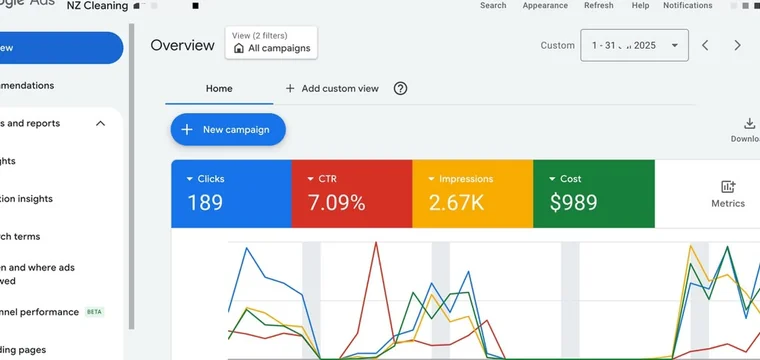
Search Demand Lift With Controlled Spend
A Google Ads campaign snapshot recorded 189 clicks from 2.67K impressions with $989 in spend. The account had enough search-volume and cost context to refine search terms, bids and ad messaging before further scaling.
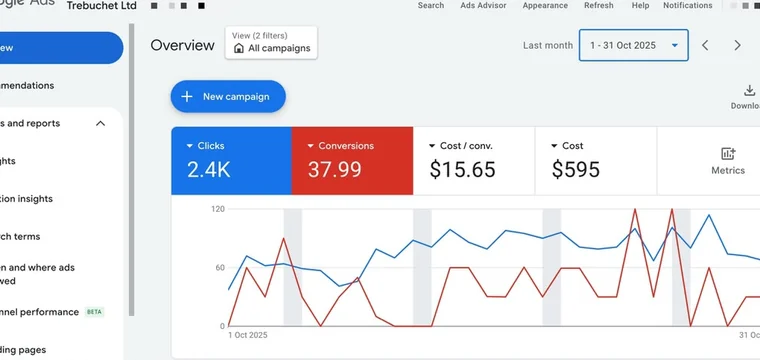
High-Volume Google Ads Conversion Tracking
Another account view recorded 2.4K clicks, 37.99 conversions and a $15.65 cost per conversion. With conversion tracking in place, budget decisions could be judged against measurable customer actions instead of traffic volume alone.
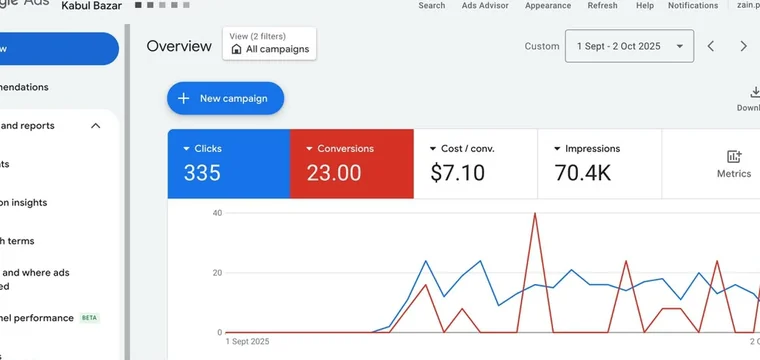
Lead Generation Campaign Performance
A lead-generation Google Ads campaign recorded 335 clicks, 23 conversions and a $7.10 cost per conversion. Search terms, conversion efficiency and lead quality could then guide the next optimization cycle.
Explore additional performance examples across paid acquisition, SEO, websites and digital growth.
View Our WorkJacksonville PPC FAQs
Know Where the Next Ad Dollar Should Go
If your Google Ads account is spending but the results are difficult to trust, start by checking the signals behind the campaign. OzoPro can review targeting, search terms, tracking, landing pages and budget allocation to identify what deserves attention first.
The goal is a PPC account that is easier to understand, easier to measure and easier to improve as real customer data comes in.